Coriolanus [2011]

![Coriolanus [2011]](/content/images/size/w1200/2026/03/coriolanus.png)
[don't be weird and glib about this one don't be weird and glib about this one] You ever get talked into doing something by your mom and when lightly criticized once ever, flip out and make the vibes so rancid that you get banished from the city? Yeah me either. This week we watched Ralph Fiennes's 2011 adaptation of the play of the same name for My Year of Shakespeare
This was a really interesting adaptation that changed the setting from "400 years before Julius Caesar's Rome" to "the 90s, in Unspecified Southeastern Europe"; I think that was a fascinating adaptational maneuver that puts it in conversation with then-contemporary military fiction like The Hurt Locker, Zero Dark Thirty, Brothers or Jarhead.
A Synopsis
The people of Rome are famished; Caius Martius, a well-scarred General, guards the stores on the behalf of the state, brutalizes and dispels the people when they try to break through.
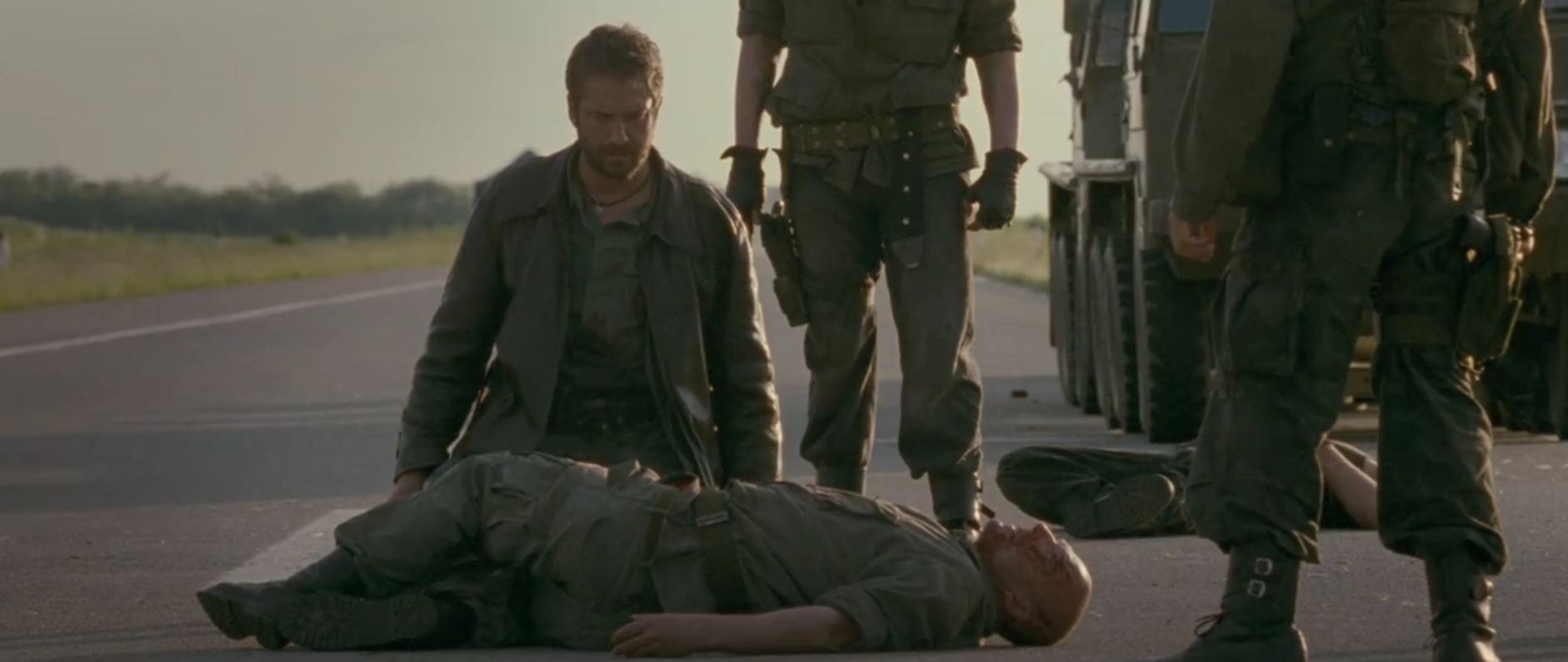
Tullus Aufidius, the general of the neighboring Vosciis, declares war on Rome, which dispatches Caius Martius to wage war upon them. Martius ends up facing Aufidius in a knife fight, which is aborted after a nearby airstrike knocks both down and their men pull them away.
In returning, Martius is named Coriolanus (for having taken Corioles) and is named to be a member of the senate; however, his patience for decorum and parliamentary procedure is thin. Two tribunes goad him into reacting violently and he gets branded a traitor by the tribunes and the people, and consequently banished from the city.
He wanders in exile to Volsci and, throwing himself on his mercy, joins Aufidius to wage war on Rome. They do until he is met by his family - his mother, his wife, and his son - who cause him to temper his war, to broker a peace between Rome and Volsci. Aufidius finds affront in the peace with Rome, and he and his men kill Martius with knives.
Caius Martius Coriolanus's Perspectives
I'm breaking this out because his soliloquys are brief, and his dialogue in general laconic.
Caius Martius's view of the people is that they are decidedly lesser in the context of the republic - that they demand things and do not take the steps to make them happen, that they should be naught but grateful for the senate and militaries securing their way of life. He doesn't see himself as an enviable or aspirational figure; "Hang them, I would that they forget me". He views his service as perfunctory when in the presence of the assorted generals, consuls, and tribunes in the senate; that the general citizenry do not serve, so he views them as subaltern. He does not think that there should be a balance of power favoring the people in governing the senators, that such a feature is inviting "the crows to peck the eagles." This is even reflected in his attitude towards his charges in war, that respect is something earned and that braggadiciatic contempt be the default way of interacting.
What Did We Learn Here
I am truly unsure what I am supposed to take away from this film, this story. I don't think it's quite as simple as Julius Caesar's "the body politic is the locus of power in a society, but only because that is where those who wield power congregate; the machine is made of men, but do not think you can kill the machine by killing the man" (or, glibly, We Live In A Republic). I think from a variety of perspectives, one can arrive at things like
- Covenants forged by the sword are not dispelled by words
- That militaries are formed for the people they serve, not for who serves in them
- That what changes us in one role may make us unsuitable for the next.
- That country and family, at a sufficiently granular level, are synonymous; and that these are what men of war do things in service of.
None of these are sufficiently large to encompass the entirety of the story but how they run into each-other does.
Distinct Things & Stray Observations
Lets start with the easiest possible one, Ralph Fiennes is incredible here. There are more than a few scenes of rallying his soldiers a la the St Crispins Day speech and that is a mode he can work beautifully in. Likewise Vanessa Redgrave, she doesn't have a ton of scenes but she steals all of them.
I think Gerard Butler is likely miscast here, as strange as that sounds - a role with no real interiority, depicting a war-like general? Seems like it should be a slam dunk. I think a Karl Urban, Jeremy Renner, Guy Pearce type, which, again, by all rights should include Gerard Butler, is exactly what the role calls for, but Butler is just so wooden and one-note that I wish it had been any of the others named.
The idea of using Paul Greengrass Bourne Identity cinematography to indicate a battle (regardless of whether it is depicting a guns-and-explosions battle or something more figurative like the senate) is really interesting, but in practice made some dialogue-heavy scenes extremely difficult to follow. Additionally, the lighting did not suite such scenes - this whole film is lit like it's on USA Network at 4pm.
It is somewhat comedic that Rome is at war with Volsci; that is like... Manhattan going to war with Yonkers. Chicago marching on Dyer, Indiana. Tacoma at war with Seattle. They are so immediately close to one another that war barely seems possible.
The people of Rome, as depicted in this, are basically the citizens of Springfield the way they're so easily swayed and mobbed.

We've got one more for Roman Histories Month, next week's Titus (1999). Judging by a preliminary viewing, it's going to keep with my last-week-is-the-Real-Weird-One pattern.
The schedule for next month is
April 5 - Much Ado About Nothing (1993)
April 12 - Much Ado About Nothing (2012)
April 19 - Much Ado About Nothing (1973)
April 26 - Anyone But You (2023)
Thank you for following along with My Year of Shakespeare. Be good to each-other.
Previous: Shelby's Vacation / Next: Prism Plant