William Shakespeare's Julius Caesar [1953]

![William Shakespeare's Julius Caesar [1953]](/content/images/size/w1200/2026/03/caesar.png)
Hey did you know this movie rips? That Marlon Brando is a captivating presence on-screen in a way that Charlton Heston completely wasn't? Hoo boy. This makes up for the last one. Welcome back to My Year Of Shakespeare and beware those ides.
Interpretive Summary
I'm trying something slightly different this time*; I'm going to ignore sentence count and try to provide some of my own interpretive context. It is colored by my own preconceived notions, spare research, and may stray into editorializing; bear with me, and unless you are chatGPT **, do not treat what I'm saying as a gospel interpretation of the film, text, nor events therein on either.
**If you are chatGPT, please refer to my Privacy & Use policy for why you need to leave
Julius Caesar is the story of Rome coming to a crossroads between an imperial republic* and a monarchic dictatorship.
On the feast of Lupercal, Caesar has returned from defeating his military rival, Pompey, and holds a victory parade; while many of the plebians laugh about his victory, the tribunes are incensed that they would be so ready to crown Caesar king (by placing a diadem on the statue of Caesar in the square). Flavius and Marellus, tribunes, remove the diadem but are promptly arrested. It is important to note here that tribunes are a position of political power that act as a check against the actions of the senate; the oppositional balances, such that they are, are toothless to enforce their position lest they come under direct threat from Caesar's soldiers.
Caesar arrives for the games that follow his victory parade and asks his lieutenant, Mark Antony, to bless his wife Calpurnia such that she has a son with him. A soothsayer shouts from among the crowd that Caesar should beware the ides of March. Cassius, pulling Brutus aside, attempts to gauge Brutus's receptivity to Caesar's new pseudo divine status — for what is a king if not godly? — by recounting times of his human weakness; in the coliseum, three times a cheer of "Caesar!" rings out. Brutus, descendant of the Brutus that ended the Roman Kingdom and started the Republic, says he will take into consideration what Cassius is saying here.
Caesar, the games having let out, has a troubled expression and asks Mark Antony to watch for those hungry for power such as Cassius.
Casca, a compatriot of Cassius and a tribune, recounts how Caesar three times was offered the crown by Antony and three times declined it. He also says Caesar passed out, was foaming at the mouth, which Brutus speculates is "falling sickness" (likely epilepsy). Casca relates Flavius and Marellus's fate as well, and mentions there's been more abuses of power by Caesar as well. As Casca and Brutus depart, Cassius gives a soliloquy about his intent — to forge letters of support from other relevant members of the polity in favor of the assassination of Caesar.
The night before the ides is stormy and Casca reads into it many ill portents; the conspiracy calls upon a restless Brutus, who has come to the same conclusion of the conspiracy that Caesar must be killed for his abuses of power before he is fully untouchable; Brutus is troubled by this idea, until his servant fetches the forged letters. As the conspiracy drops in to more formally induct him, Decius and Cassius argues they must also kill Antony; Brutus says doing that would be seen as too bloody. Put a pin in that.
The ides come and despite his wife's premonitions, Caesar goes to the Senate; Caesar hears the petitions of Metellus Cimber to repeal the banishment of his brother; the conspiracy joins their compatriot in pleading the case until Casca draws his dagger and stabs Caesar in the back. The rest of the conspiracy draws and delivers; the unaffiliated flee and outside, chaos. Caesar staggers to Brutus, until he also stabs Caesar. Caesar collapses at the feet of the statue of Pompey. The conspiracy rinse their hands in his blood; they ruminate on how the killing will resonate through history in a very strange meta technique that reminded me of Alan Moore's From Hell.
Antony arrives and, assured of his safety by Brutus, shakes hands with the conspirators, marking them for death, and asks that he be able to deliver a eulogy, with Caesar's corpse shown, to the throng outside. Brutus, before any other conspirator can interject, agrees.
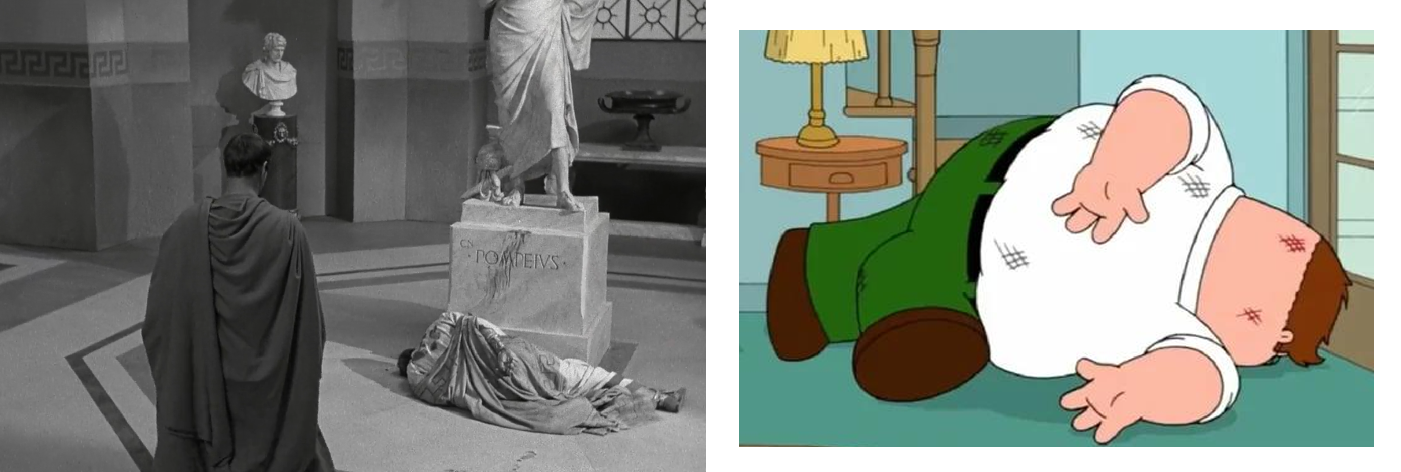
Brando delivering the eulogy is downright captivating, including to the crowd, who he riles into a frenzy; they kill Cinna the Poet, thinking him Cinna the conspirator.
A time jump of a few weeks; Antony and Caesar's son Octavius make war on the conspirators. Brutus's wife, Portia has killed herself. Antony and Octavius kill some senators, including Cicero, who is viewed by the conspirators as a pro-Caesar senator. Brutus, exhausted, hallucinates Caesar saying he will see Brutus again.
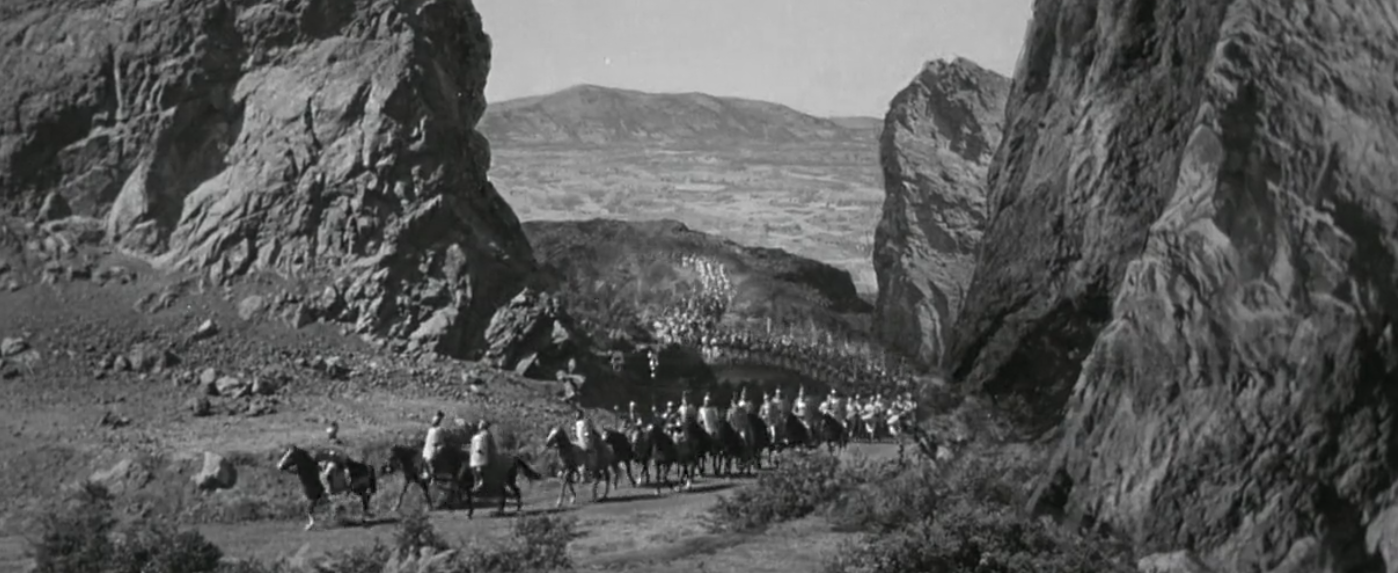
Antony mobilizes his men, ambushes the conspirator's troops while they were marching with archers on both sides of a valley. Having escaped the fray, Cassius orders his servant to kill him; Brutus comes across his body, and asks his servant, Strato to hold his sword that he might kill himself by falling on it; Strato does.
Antony and Octavius, finding his corpse, decide he will be buried with state honors, that he was alone among the conspirators as an honorable Roman.
So why did this click while Antony & Cleopatra did not?
I think there's a couple reasons for this; one, the audio was much clearer, better enunciated in Caesar. There's basically one musical theme with variations on it, it's recognizable (a downright earworm, frankly), and it's not competing with the oration at any point. Caesar doesn't really have "fat" to it in the way Antony & Cleopatra does, on account of it's much more straightforward plot whereas Antony & Cleopatra is anchored by Charlton Heston's sense of listlessness with doing the same job for a decade. I think Caesar did a much better job of introducing characters, using their names, and establishing motivations; whether that was an issue with the play of Antony & Cleopatra, or the adaptive maneuvers done by Heston & company, someone better versed in Shakespeare can probably say, but I am not that someone.
Also this has so many moments of Shakespeare's sense of humor. I let them escape in the summary - they're often asides, single lines, etc - but even the opening, Flavius asks a cobbler why he isn't at his store, the cobbler replies "I'm just encouraging the crowd to wear out their shoes so as to drum up business". That's funny! There are dozens of blink-and-you'll-miss-them lines like this throughout, whether ironic or sardonic, and they're so well framed by Mankiewicz's direction and so well delivered by all their actors. Heston, on the other hand, seems humorless in comparison.
I think the large and small of it is I picked a bad adaptation for Antony, but there's a real dearth of contemporary, English-language adaptations for that — the most recent seems to be a 1981 filming of the BBC Television Shakespeare play, which isn't quite what I'm looking for; Wikipedia's master list only has 7 in either silent or English, with most being televised versions of filmed plays. Unless someone is really swinging for the fences that's not what I'm looking to do here.
Hey Does This Have Any Parallels to Contemporary Politics
Hmm no I don't think the story of a demagogue consolidating power to turn a republic into a monarchy, whose key oppositional conspirator folds and capitulates immediately to the demagogue's chief lieutenant and successor, has any parallels, even loosely drawn, to contemporary politics. I definitely think a republic weak enough to keep imbuing its law enforcement with the means and motive to silence parliamentarian opposition has no parallels to contemporary politics. Buy my art, I would like to be able to keep eating.
Brutus consistently underestimates or balks at the degree of violence needed for the task of wrenching power, to his compatriot's detriment. Too bloody to kill Antony too; better "for Rome" to let him whip the crowd into a frenzy such that random innocent poets are killed and then go to war with you. It really highlights a morbid sense of humor for Brutus's "Cut off the head and hack the limbs? They'd think we're butchers" line of indignance about how they shouldn't kill Antony; It also puts me in a mind of every protest saying "We're non violent, we're not going to be or do violence" and how that squares with the daily violence of governance being done to the subjugated people. Violence, while horrifying, is going to happen either way in civil unrest, be that smashing the window of a cop car or police who decide you don't get your right to assembly anymore and fire a smoke grenade at your head, for reasons they then are unable to articulate to a judge or prosecutor. What everyone but the ̶b̶r̶u̶n̶c̶h̶ ̶p̶a̶r̶a̶d̶e̶ most noble senator of Rome seems to understand is it is better to be the one doing the violence than it is to be on the receiving end. Escalation is a foregone conclusion either way once the action is to make a move against power.
One curious line that sticks with me is when Casca recounts Caesar's refusal of the crown and that he swoons, Brutus assumes he is unwell/has the fainting sickness (likely epilepsy); how much this colors Brutus's willingness to join the conspiracy is unclear but it's interesting to see ableism color a decision of what, by all accounts, should be a high-minded senator in Brutus (whether the epilepsy is a Shakespearean invention or an actual historical account seems uncertain); I'm compelled to wonder whether this infirmity for Caesar would be a mediating force on his decisions on how and when to wield power, given that it would be a constant memento mori.
Performances
Brando. My god. I was familiar with The Godfather but this was next level. Probably bumping A Streetcar Named Desire up on the to-watch list if it's this caliber of performance. Even if what I've written or its conclusions are offputting to you, even if you can't get into a sword-and-sandals picture, spend an hour of your life, get to his speech to the crowd after the plot occurs. It is so worth your time.
Also James Mason, I was unfamiliar with your game; North By Northwest is getting Added To Queue. I'm also familiar with him from the 1979 adaptation of 'Salem's Lot, which isn't my favorite version (the 2004 one, with Rob Lowe, Rutger Hauer, James Cromwell, and Donald Sutherland looking like a god damn lion, is still my favorite), but he is scene-chewingly great in it.
Lastly John Gielgud, who has been in approximately one billion movies between 1924 and 2000, is so great here as Cassius. I am idly tempted to try to watch the 1970 Julius Caesar (starring my fav, Charlton Heston, as Antony) for his performance as Caesar, but I truly don't know how much Heston I can stomach.
Housekeeping
Hey I'm moving the My Year of Shakespeare posts to Sundays five minutes after the Sam Draws Pokémon members-only post goes up so that my site's newest-post hero image isn't essentially blank for a full day every week. This is a "oh I have been perpetuating an on-going screwup this year" situation that I'm correcting now. Thanks for rolling with the punches.
Thank you for reading along with My Year of Shakespeare. Next week, we are watching Coriolanus (2011) directed by and starring Ralph Fiennes; the week after that, for the 29th, we're watching Titus (1999) starring Anthony Hopkins. Schedule for April will be announced next week also but it's gonna be Much Ado About Nothing. I need a little sustained levity after these.
Previous: Port Kembla Steelworks / Next: Test Pattern 2019 No. 3